Equestrian Fans
Improve Airflow, Comfort And Conditions Across Your Equestrian Facility
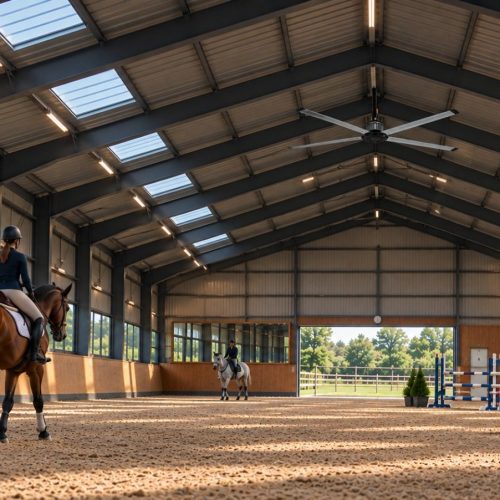
Indoor riding arenas, stables, barns and training buildings can be difficult spaces to ventilate evenly. High roofs, enclosed stalls, partitions, arena surfaces, changing occupancy and limited natural air movement can all create warm, humid or stagnant areas for horses, riders and staff. A properly planned equestrian airflow system helps move air more consistently through the areas where it is actually needed.
MegaFan AirMax HVLS fans for equestrian facilities are designed to move substantial volumes of air quietly across large indoor spaces. Used as part of a suitable ventilation strategy, AirMax can support warm-weather comfort, heat-stress management, humidity control and the reduction of stale air, airborne dust and persistent odours, helping create more comfortable conditions for both horses and people.
The system can be designed around indoor riding arenas, stables and barns, training schools, livery yards, equestrian centres, round pens, lunging areas, wash bays, grooming areas and indoor horse walkers, with fan size, position, mounting height and control strategy selected around the building layout, horse movement, roof structure, surface conditions and existing ventilation
≈850 W full-speed cooling.
One Equestrian Facility Can Need More Than One Airflow Strategy
Indoor riding arenas, stable blocks, American barns, training schools and livery centres can contain very different airflow conditions. High roofs, stable partitions, arena walls, horse positions, riding areas, grooming zones and door openings can all influence how effectively air moves through the building.
A successful equestrian airflow strategy should therefore consider the horses, riders, staff and building together, with air movement planned around the actual occupied areas, roof structure, arena surface and existing ventilation.
Horse-Level Airflow
Air movement should be assessed around stalls, standing areas and normal horse positions.
Arena Conditions
Riding surfaces, dust, moisture and arena geometry can influence the required airflow strategy.
Building Layout
Stable partitions, roof steelwork, doors and internal structures can change airflow paths.
Existing Ventilation
Natural openings, roof outlets and mechanical ventilation should be considered together.
Indoor Arena Air Movement
Large riding arenas can require broad, gentle circulation across wide occupied areas while accounting for horses, riders and arena surfaces.
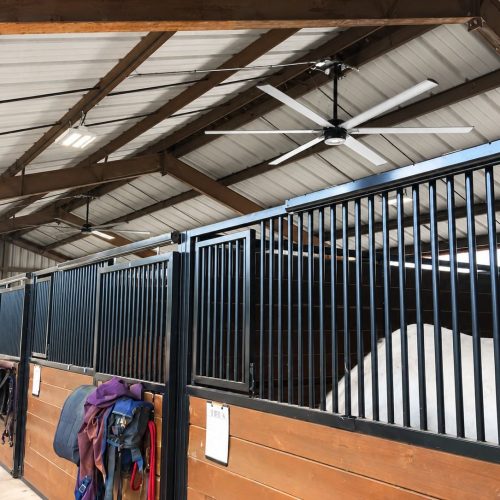
Stable & Barn Airflow
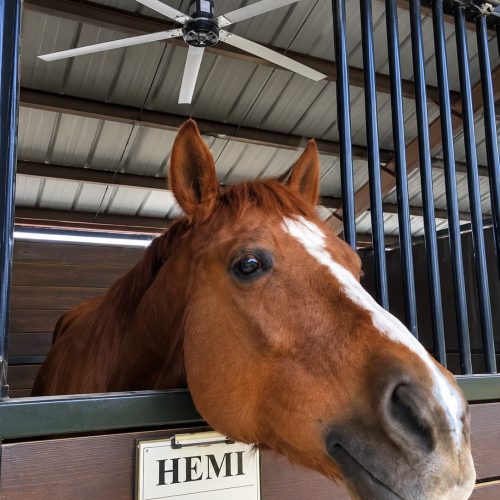
Stable blocks and barns need airflow planned around stalls, partitions, horse standing areas and the building’s existing fresh-air openings.
Humidity, Moisture & Dust
Air circulation can support the wider management of humid conditions, moisture and airborne dust when coordinated with the building ventilation strategy.
Year-Round Airflow Control
Different operating speeds and airflow strategies can be used as conditions change between warmer summer periods and colder winter operation.


Engineered For Horses
AirMax is built using premium materials and precision engineering to create a healthier environment for horses and people.
Reduce Heat Stress
Provides consistent airflow that reduces heat stress and improves comfort.
Manage Humidity & Moisture
Helps reduce humidity and moisture build-up, minimising the risk of respiratory issues.
Improve Air Quality
Reduces airborne dust and odours for improved air quality throughout the facility.
Quiet Operation
Durable, quiet operation designed not to unnecessarily disturb horses.
Reinforced Aluminium Blades
Extruded aluminium blades with internal reinforcement for maximum strength and longevity.
Built For Continuous Use
Designed for continuous daily use in demanding equestrian environments.
Ready To Improve Airflow Across Your Equestrian Facility?
Tell us about your equestrian building, indoor arena, stable areas, roof height, horse boxes, occupied zones and existing ventilation. Our team can help recommend the right AirMax fan size, quantity, positioning and control solution for your facility.
- FAQS
Frequently Asked Questions
Planning airflow for an equestrian facility involves more than choosing a fan diameter. Indoor arenas, stables, barns, livery yards and training buildings can all have different roof heights, partitions, horse locations, surface conditions and ventilation requirements.
Is AirMax Suitable For Indoor Riding Arenas?
Yes. AirMax is designed for large buildings including indoor riding arenas. The final fan size, quantity and position should be selected around the arena dimensions, roof height, structure, surface conditions and airflow required.
Can AirMax Be Installed In Stables And Barns?
Yes, where the building height, mounting structure and required clearances are suitable. Stable partitions, horse positions, roof structure and other obstructions should all be considered when planning the airflow layout.
How Can AirMax Help Improve Conditions For Horses?
AirMax provides wide-area air movement that can support warm-weather comfort while helping manage humidity and moisture build-up. MegaFan also positions the system as helping reduce airborne dust and odours through improved air distribution.
Is AirMax Quiet Enough For Equestrian Buildings?
The quiet operation designed not to disturb horses. Published sound levels across the AirMax range are approximately 52–54 dB(A), depending on the model.
Does AirMax Bring Fresh Air Into A Stable Or Arena?
No. AirMax primarily circulates and redistributes air already inside the building. A suitable natural or mechanical ventilation system is still required where fresh outside air needs to enter or stale air needs to leave the facility.
How Do You Decide How Many AirMax Fans An Equestrian Facility Needs?
Approximate coverage ranges from 800 m² for the AirMax 400 to 2,325 m² for the AirMax 730, but these figures are only a starting point. Installation height, arena walls, stable partitions, roof structure, doors and other obstructions can all affect actual airflow and fan positioning.
Can AirMax Be Automated Or Connected To A Building Management System?
Yes. AirMax can be used with MegaFan’s controller range, including the Smart HVLS Controller for more advanced automated operation and building-management integration. The exact controls and BMS interface should be confirmed as part of the project specification.