
Sustainability & Carbon Reduction

Use Less Energy to Create Better Building Conditions

MegaFan HVLS systems can support lower operational carbon by reducing wasted heating energy, improving the distribution of conditioned air and operating only when the building requires airflow.

The credible route is simple: establish the energy baseline, design the correct system, measure the reduction, subtract fan electricity and convert the net energy saving into carbon dioxide equivalent using the appropriate reporting factor.

Carbon Reduction Starts With Energy Reduction
Airflow Is The Mechanism.
Lower Energy Use Is The Carbon Result.

A HVLS fan does not remove carbon dioxide from the atmosphere. The potential operational carbon benefit comes when the completed airflow system allows the building to use less fuel or electricity while maintaining the required internal conditions.

During winter, destratification can redistribute useful warm air trapped near the roof back towards the occupied zone. During warmer periods, air movement can support perceived comfort and help distribute conditioned or supplied air more effectively through the building.

Any carbon calculation should use the net energy result. Electricity consumed by the fans, controls and any additional equipment must be included, and the remaining energy reduction should be converted into COâ‚‚e using the appropriate emissions factor and the organisation's reporting methodology.

The key principle: installing an HVLS fan does not automatically create a carbon saving. A carbon reduction exists where the completed system produces a genuine net reduction in energy use, supported by measurement or an appropriate project-specific assessment.
Winter

Lower Heating Demand

Destratification can redistribute warm air that would otherwise remain near the roof, helping the heating system maintain the required occupied-zone temperature while potentially requiring less heating energy.

Distribution

More Efficient Air Distribution

HVLS circulation can help move heated, conditioned, fresh or dehumidified air through a larger part of the building instead of allowing it to remain concentrated close to its supply point.

Controls

Smarter Operating Hours

Compatible controls, speed settings, schedules, sensors and zoning can match fan operation to the time and output actually required, helping reduce unnecessary equipment operating hours.

Verification

Measured Carbon Evidence

Measure or reasonably establish the net energy reduction first, then convert the verified kWh or fuel saving into COâ‚‚e using the relevant emissions factor, reporting year and organisational methodology.

Carbon reduction should be reported from net energy savings. The emissions associated with electricity consumed by the fans, controllers and any additional equipment should be deducted when assessing net operational carbon reduction. A wider whole-life carbon assessment may also consider manufacturing, transport, installation, maintenance, replacement and end-of-life impacts.
University of Liverpool CFD Study

Modelled Heating-Energy Reduction Can Be Converted Into Operational COâ‚‚e

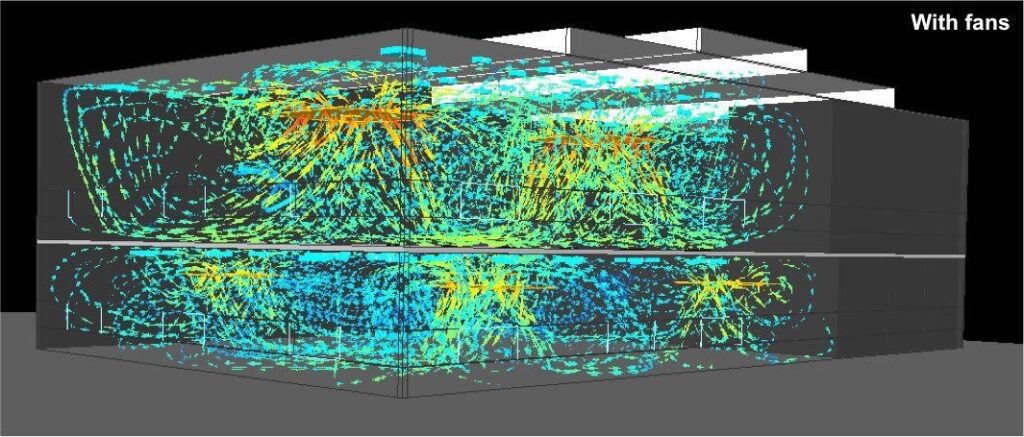
MegaFan commissioned Dr James Forrest and Prof Ieuan Owen of the University of Liverpool Engineering Department to model airflow and heat transfer in a heated warehouse environment.

The study used a repeatable 30 m by 30 m warehouse zone with apex heights from 12.5 m to 20 m and a target average temperature of 16°C at 1.5 m above floor level.

The report compared heater power with the HVLS fan operating and not operating. It did not calculate carbon directly, so any COâ‚‚e estimate should convert the modelled energy reduction using the relevant fuel or electricity emissions factor and then allow for fan electricity use.

30 Ă— 30 m Generic repeatable warehouse footprint
12.5–20 m Four roof-apex heights studied
16°C Target at 1.5 m above the floor
32–45% Modelled heater-power-saving range in key examples
University of Liverpool modelled absolute power savings chart
University of Liverpool modelled percentage energy savings chart

Figure 10: Modelled absolute power and percentage energy savings

The report indicated approximately 32% heater-power saving for the 12.5 m apex case and 40–45% for the 15–20 m cases at 4°C outside. These are model outputs and should be treated as study-based illustrations rather than guaranteed site savings.

Interactive Operational Carbon Calculator

Estimate Net Annual Energy & COâ‚‚e Reduction

Change every input to match the project. The default emissions factors are rounded planning examples only. Confirm the correct factor, reporting year, energy source, unit and reporting methodology before using the result in formal carbon reporting.

kWh
Use the energy affected by the proposed project, not the whole site total unless all of it is relevant.
%
Use a project-supported figure. Do not treat research examples as guaranteed site savings.
kg COâ‚‚e/kWh
0.182 is the editable rounded planning example contained in the source calculator. Replace it with the approved factor for the actual energy source and reporting year.
Include every fan expected to operate in the assessed mode.
W
300 W is an editable AirMax 730 winter-operation example from the source calculator, not a universal fan consumption figure.
hrs
Use expected annual hours after schedules, seasonal operation and occupancy are considered.
kg COâ‚‚e/kWh
0.131 is the editable rounded UK-grid planning example used in the supplied calculator. Confirm the appropriate reporting factor before formal use.
years
This simple total does not account for future emissions-factor changes, degradation or changes in building operation.
Important: this calculator estimates operational emissions only. It is not a quotation, verified carbon footprint, life-cycle assessment, SECR disclosure, financial advice or performance guarantee.
Illustrative Net Result

Your Editable Carbon Estimate

Gross Energy Avoided 0 kWh Before fan electricity
Gross Emissions Avoided 0.0 tCOâ‚‚e Energy saved Ă— avoided-energy factor
Fan Electricity 0 kWh Fan count Ă— kW Ă— annual hours
Fan Electricity Emissions 0.0 tCOâ‚‚e Fan electricity Ă— electricity factor
Assessment-Period Reduction 0.0 tCOâ‚‚e Simple net annual result Ă— selected years
Enter the project assumptions to calculate an illustrative result.

Frequently Asked Questions

How can an HVLS fan reduce carbon emissions?

An HVLS fan can reduce operational emissions when it lowers the energy required for heating, cooling or air distribution. The carbon reduction comes from verified energy savings after subtracting the electricity used by the fan and controls.

No. Airflow alone is not a carbon saving. The building must use less energy overall, and that reduction should be measured or supported by a project-specific engineering assessment.

The computational warehouse model indicated approximately 32% heater-power saving for the 12.5 metre apex case and 40% to 45% for the 15 to 20 metre cases at an outside temperature of 4 degrees Celsius.

Use the factor for the reporting year, activity, fuel, unit and organisational method. UK organisations can use the latest relevant UK Government greenhouse-gas conversion-factor workbook and should retain the factor source in their calculation records.

Air movement can improve perceived comfort and distribute conditioned air. A carbon saving is possible only where this enables a verified reduction in air-conditioning energy, operating hours or another relevant load.

Use the Request ROI Calculation or Book a Site Survey page, call MegaFan on 0161 426 0218 or email sales@megafans.co.uk with building dimensions, energy data, operating hours and photographs.

Any Questions just Contact Us